Send email
With fallback to private address or manager, and a preview beforehand.

Product · Automation
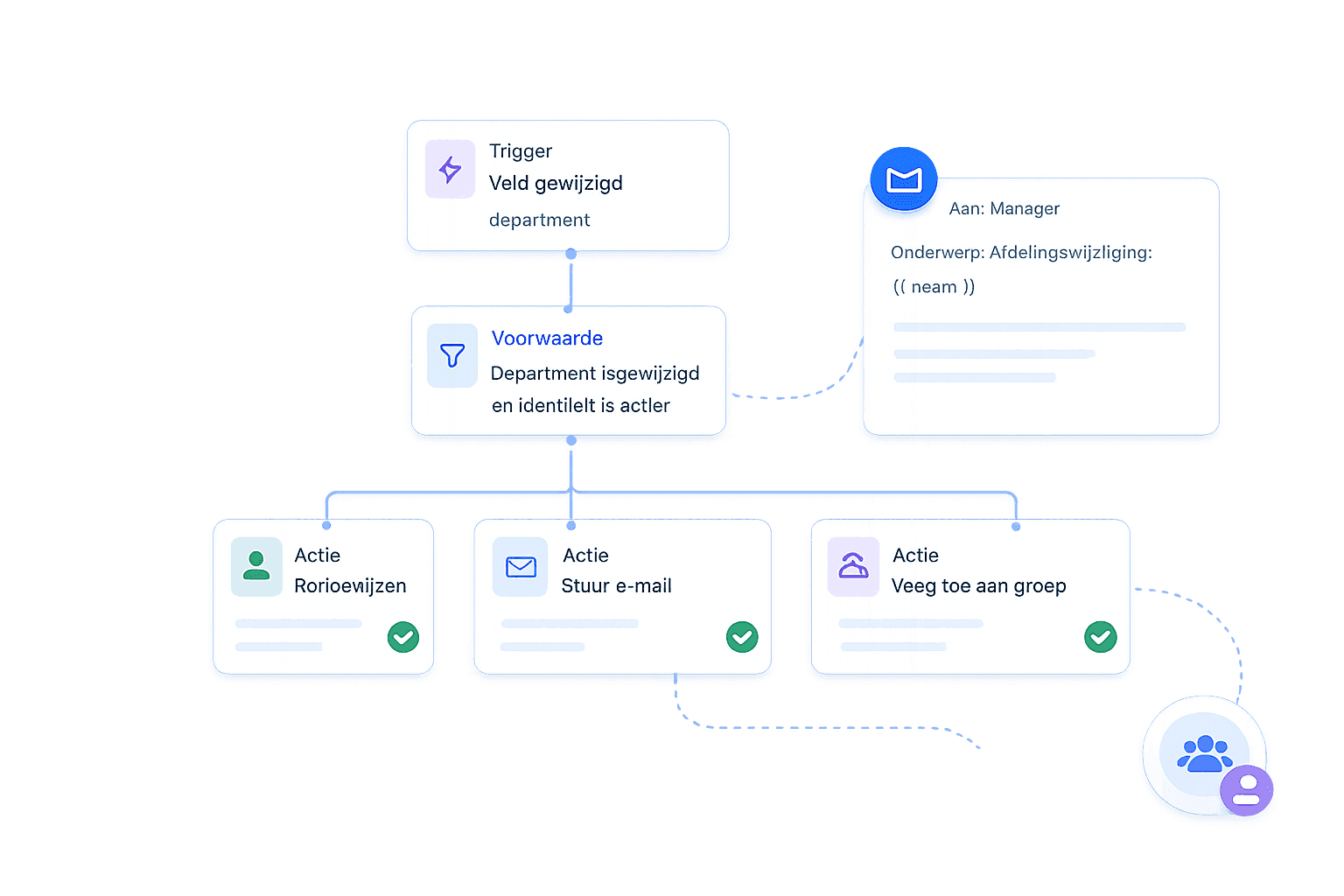
One trigger, conditions, and a series of actions—that is all a workflow is. This allows you to automate everything you currently handle per ticket, from a welcome email to clearing a calendar upon departure.


In many organisations, nothing happens on that day. The account remains open for weeks, the licence continues, and the team calendar is full of meetings with an empty chair.
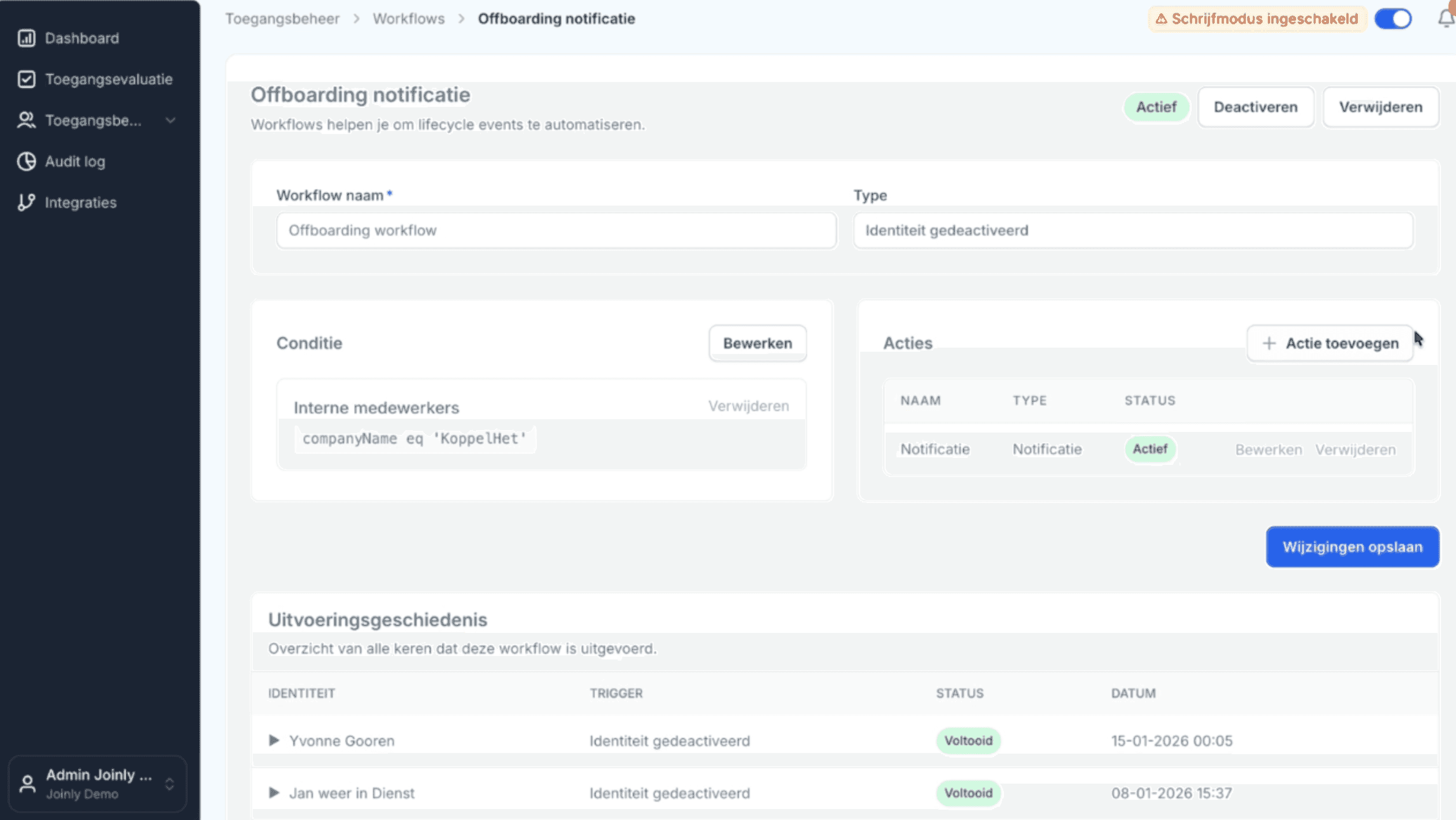
With a Joinly workflow, the offboarding date from HR triggers the entire process: the account is disabled and active sessions are revoked, the Microsoft 365 licences are released, the out-of-office is enabled with a referral to the manager, the calendar is cleared, and a ticket automatically appears in TOPdesk for the collection of the laptop. As a final step, a task is ready for archiving the mailbox — waiting for approval from IT. Every step is logged. No checklist, no forgotten steps.
That is one workflow. This is how you create one for every moment in the lifecycle.
New employee in HR → account with the correct roles, licences and groups, a welcome email to the private address, the password via SMS, and a ticket for the laptop. Ready before the first working day.
Job role or department changes in HR → old permissions removed, new ones added, manager updated. Without anyone having to create a ticket.
Last working day → account disabled, sessions revoked, licenses freed, out-of-office enabled, calendar cleared, service desk ticket for the hardware.
A workflow is nothing more than this: one trigger (an event, such as "Employee offboarding"), filter conditions (for example: only the field service in Zwolle) and a series of actions that are executed in order. Before you activate anything, the preview shows exactly which people it affects, so you never automate blindly.
You build it in a visual editor, no scripts, no code that no one dares to touch anymore.
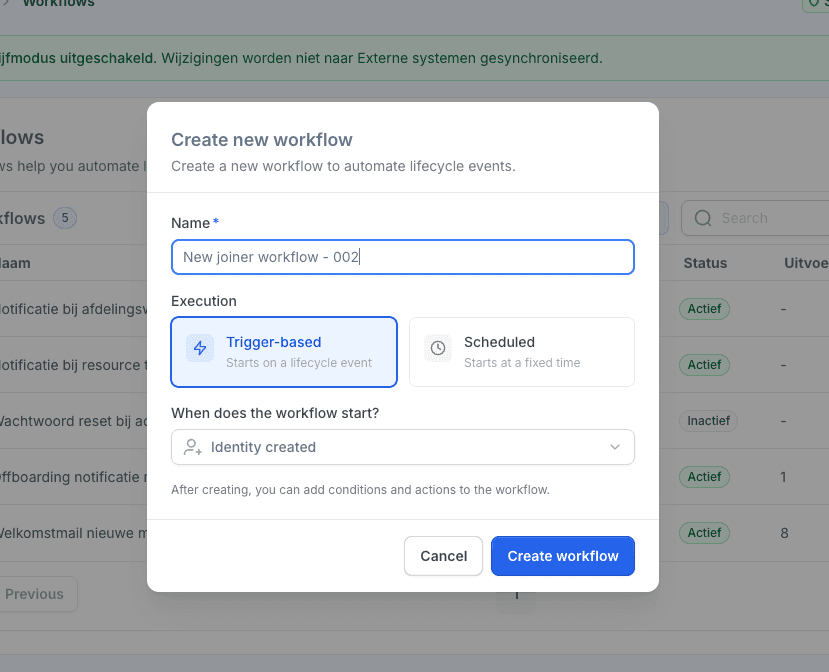
Combine them in any order into the exact flow your process requires, from a simple email to a complete offboarding.
With fallback to private address or manager, and a preview beforehand.
A secure reset link sent directly to the employee.
A priority notification for the administrator or the team.
Set up a step that only proceeds after approval.
For example, the first password during onboarding.
Trigger another system as soon as this step runs.
Conditional roles that follow the job title; SoD.
Actual vs. intended access, corrected with a single click.
Access requests: Self-service requests, managers approve.
Access requests: Self-service requests, managers approve.
Optionally with "change upon next login"
Temporary access for the first login, without a password.
Terminate active sessions immediately upon offboarding.
Automatic, with reference to the manager.
Free up meeting rooms and calendars of leavers.
Clean deletion, with recovery option.
Entra or Exchange group, based on role or condition.
Revoke group membership as soon as it is no longer correct.
Keep the email address consistent in Microsoft 365.
Create accounts in on-prem or hybrid AD.
Close local accounts upon offboarding.
Add to or remove from an AD group.
Exchange remote mailbox in a hybrid environment.
Automatically create a ticket with the correct category.
Prepare a service request at the service desk.
Link each building block above to the assignment or revocation of a role. If someone is assigned the "Field Service" role, the workflow immediately handles the associated groups, licences, and notifications.
Run the same actions as soon as a license, group, or app permission is granted or revoked.
Include the access review after a change and automatically correct deviations.
Trigger a workflow for conflicting access and instantly create a follow-up task or notification for your IT team
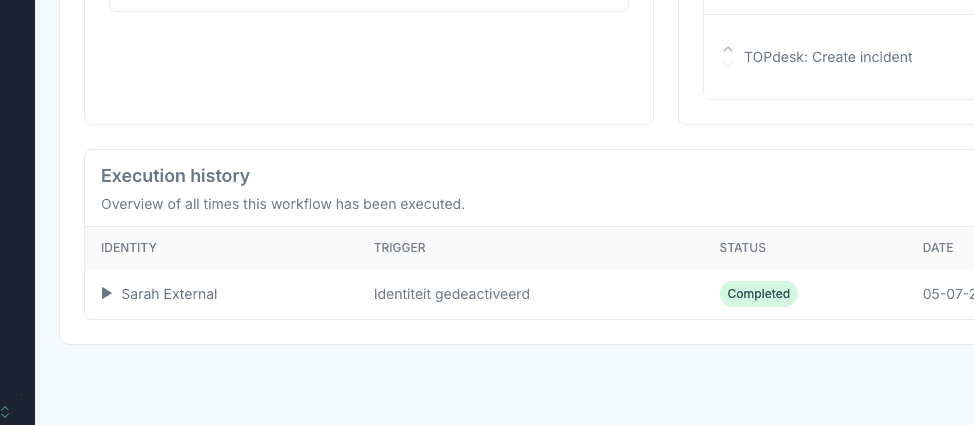
Every action has automatic retries (reattempting in case of a failure), you decide per action whether the workflow stops on error, and you link follow-up actions to success or failure — for example, alerting the administrator if an account could not be created. You can see the health and execution history of every workflow on the dashboard; failing workflows automatically surface as an attention point.
Ask away
If you're having trouble with the frequently asked questions, feel free to send us a message.
No. You build workflows in a visual editor: you choose a trigger, set conditions, and sequence the actions. No scripts, no code.
Yes. The preview shows which people currently match your filters, and "run for everyone" has its own preview before anything happens.
Joinly automatically retries (3× immediately, then after 5 minutes and after 1 hour). You decide per step whether the workflow stops on an error, and failed workflows automatically appear as an attention point on the dashboard.
Yes. With the "create task" action you set up an approval step; you can link automatic follow-up actions to both "approved" and "rejected".
Yes, via the Joinly Agent: provision AD accounts (also in bulk), manage AD groups, and create Exchange remote mailboxes.
Start a free trial today or get in touch for advice on your HR and Microsoft environment.