
Overig · Overig
What is authorization?
Authorization determines what someone is allowed to do after they have been authenticated. While authentication asks “who are you?”, authorization asks “what do you have access to?”.
Marcel van Beek · CTO · 2 min read
Authorisation determines what someone is allowed to do after they have been authenticated. Where authentication asks “who are you?”, authorisation asks the question: “what are you allowed to access?”.
In an organisation, this means that employees only gain access to the systems, files and applications they need for their work. An HR employee may view personnel data, but not financial reports; a system administrator may manage servers, but not make HR changes.
Authorisation can be managed in various ways. The classic approach is Role-Based Access Control (RBAC), where rights are granted based on role or department. A more modern variant is Attribute-Based Access Control (ABAC), which also considers context (such as location, device, or project).
Within Joinly, authorisations are automatically granted based on data from the HR system. This eliminates manual administration, and access is always tailored to the current personnel status.
Authorisation is therefore not only a security measure but also a means to reduce risks and the administrative burden.
In summary: Authorisation determines what you have access to, based on who you are and what you need.
Explore more blogs
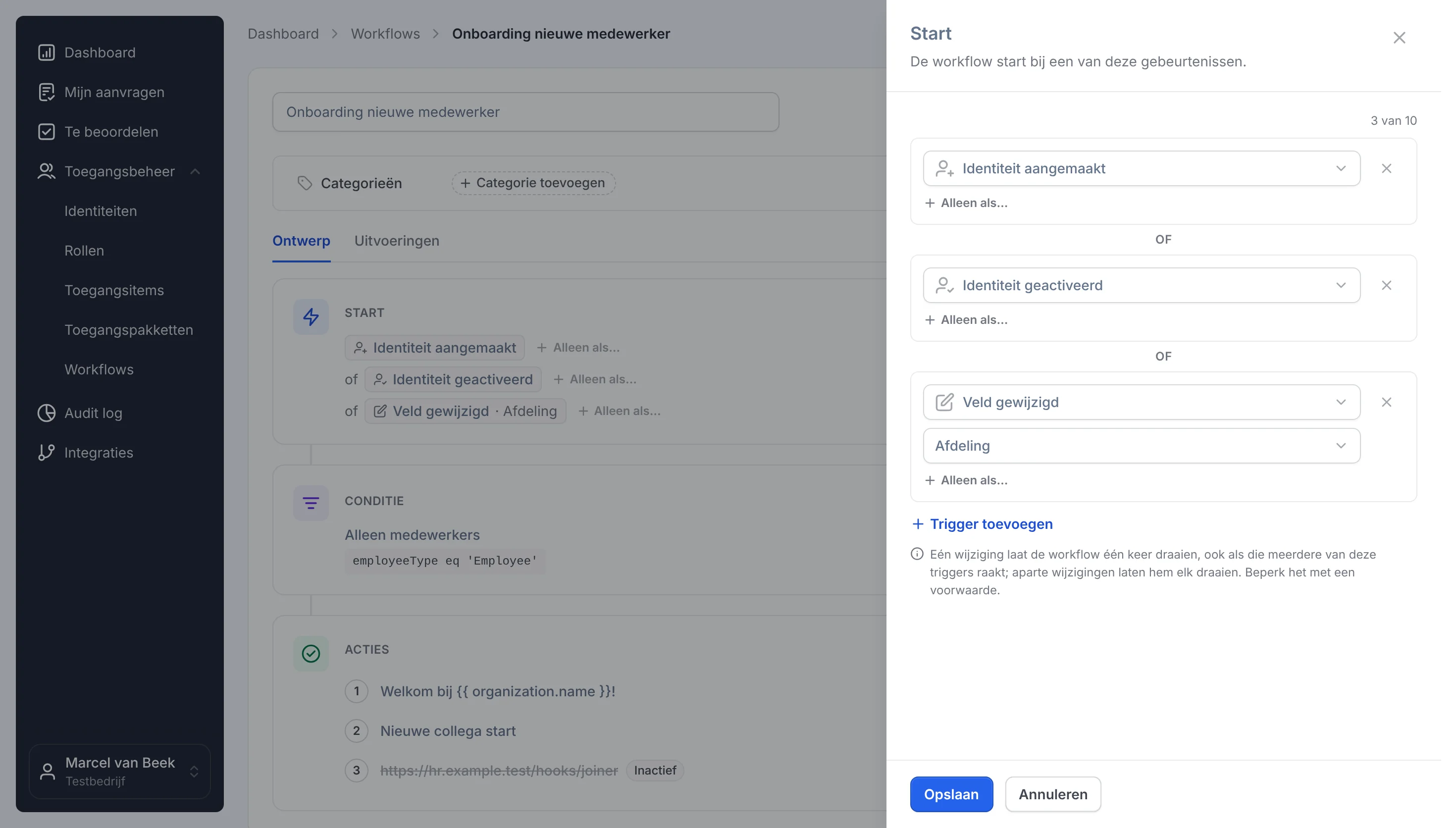
One workflow, several moments: workflows that start on more than one trigger
Created, activated or moved department: one workflow now starts at each of those moments, with a condition of its own per trigger.
Marcel van Beek · 3 min read

Segregation of Duties (SoD): wat het is en hoe je het afdwingt
Wat is segregation of duties (functiescheiding)? Uitleg, voorbeelden en waarom het vaak misgaat. Plus hoe je SoD-conflicten automatisch tegenhoudt.
Marcel van Beek · 4 min read

How do you apply AGDLP in a hybrid Entra/AD environment? (And why you shouldn't want to anymore)
Short answer: preferably not. AGDLP (Accounts → Global groups → Domain Local groups → Permissions) is a concept from the era of manual management. The entire nesting construction exists for one reason: to allow a human to assign permissions with as few mouse clicks as possible. As soon as an agent assigns group memberships directly based on HR data, this reason disappears and only the complexity remains. Moreover, in a hybrid environment, this complexity actively works against you, because Entra ID completely ignores nesting for licences and app assignment. In this article, you can read how AGDLP works and why it was once smart, where it breaks down in a hybrid environment, and what the modern alternative looks like: direct memberships, managed by automation.
Marcel van Beek · 5 min read
See what Joinly can do for your organisation?
Start a free trial today or get in touch for advice on your HR and Microsoft environment.
No credit card, nothing to install.